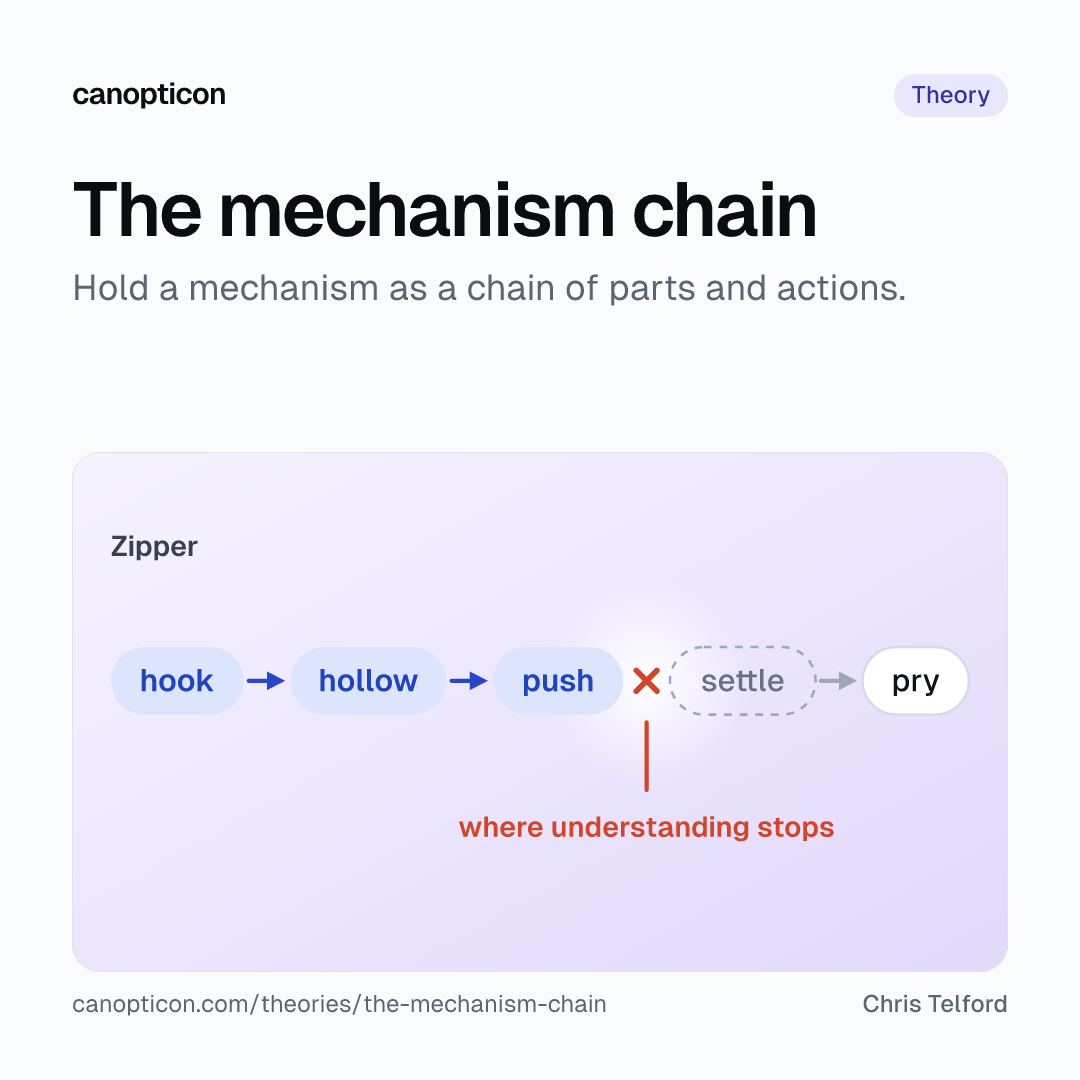
People know the things they use by what they do and how to operate them, and that knowledge is accurate, because a procedure is held as an ordered list of steps. Knowing what a thing does feels like knowing how it does it, so people rate their understanding of mechanisms well above what they can explain, and the gap shows only when they try. A mechanism is a set of parts, each doing something, in order from a starting condition to a result. It can be held the way a procedure is held: as a chain of short cue words, one part or action per link, in causal order. Learned that way and rebuilt from the words, a mechanism can be explained on demand, and the first link that will not come back shows where understanding stops.
4 strong · 5 moderate · 2 proposed propositions, resting on 19 primary references. Strong means measured directly in at least two independent studies; moderate, that it follows from established findings but has not been tested as stated; proposed, not yet tested.
Propositions
-
P1
Strong
People rate their understanding of how things work higher than they can explain, and the rating falls once they try to explain the mechanism step by step.
Across twelve studies, students' ratings of how well they understood devices such as a zipper fell after they wrote out how each one works; people asked to explain how a policy would work rated their understanding lower afterwards, and their positions became more moderate.
-
P2
Moderate
The overestimate is specific to mechanisms: it is absent for procedures and much smaller for facts and stories.
Measured in Rozenblit and Keil's studies, which compared devices with procedures, facts and narratives. Devices showed a large drop in rated understanding after an explanation; procedures showed none. One set of studies.
1 reference: [1]
-
P3
Moderate
Familiarity with an everyday object does not bring knowledge of its mechanism.
Asked to complete drawings of a bicycle, people made frequent and serious errors, such as running the chain around the front wheel as well as the back; bicycle experts made fewer errors but still made some. Measured for one object.
1 reference: [3]
-
P4
Moderate
One source of the overestimate is that knowing what a thing does, and how to use it, is taken for knowing how it does it.
Rozenblit and Keil proposed that people confuse an understanding of a device's high-level function with an understanding of the mechanism beneath it; Keil lists this as one of two sources of the illusion. Proposed in those papers, and not isolated in an experiment.
-
P5
Moderate
A mechanism is a set of parts and what each part does, in an order that runs from a starting condition to a result, so explaining one means naming those parts and actions in order.
The standard definition in the philosophy of science describes mechanisms as entities and activities organised to produce changes from a set-up to a finish; a framework for students' mechanistic reasoning built on it lists entities, activities and chaining from one stage to the next. A definition, not a measurement.
-
P6
Moderate
People work out how a machine moves by following its chain of causes one link at a time.
From eye-fixation, accuracy and timing data, Hegarty proposed that people inferring motion in pulley systems simulate each interaction between parts in turn and trace the chain of causality across the system. One programme of studies, with mechanical diagrams.
1 reference: [7]
-
P7
Strong
Events joined in a chain of causes are remembered better than events outside it.
In memory for stories, events with more causal connections, and those on the main causal chain, were recalled more often and judged more important; causal connections, with two other measures, accounted for 31% of the variation in what readers of eight short stories recalled.
-
P8
Strong
Learning a mechanism's parts and the order of their actions improves understanding of it.
Diagrams showing a system's parts and the sequence of events when it runs improved conceptual recall in 10 of 10 tests (median 57%) and problem solving in 16 of 16 (median 64%), for learners new to the topic; learning the names and behaviours of the parts before a lesson improved problem-solving transfer in 5 of 5 tests (median d = 0.85).
-
P9
Strong
Producing an explanation from memory teaches more than reading it again or arranging it into a diagram.
Students prompted to explain each sentence of a science text to themselves learned more than students who read it twice; recalling a passage beat rereading it after two days and after a week; retrieval practice beat building concept maps on tests that required inferences.
-
P10
Proposed
Procedures are judged accurately because they are held as an ordered list of steps; a mechanism held the same way, as an ordered chain of part-and-action cue words, will be judged as accurately and explained more fully.
Rozenblit and Keil suggest that procedural knowledge consists mostly of the sequence of high-level steps. No study has given people a mechanism as such a chain and measured the illusion.
No study yet
-
P11
Proposed
The first link a person cannot rebuild marks where their understanding stops, and learning that link moves the limit.
Untested. Follows from propositions 1 and 6.
No study yet
Ask someone how a toilet works and the answer usually comes out as a few words in no particular order: water pressure, tank, flush, fill. The same person uses one several times a day and could teach a child to use it. They know what it does and how to operate it. What they are missing is the order of the parts and what each one does, and they do not notice it is missing until they are asked.
This theory is about that difference, and about a way of holding a mechanism so that it can be explained.
1Definition
Use knowledge is knowing what a thing does and how to operate it: press the handle, the bowl empties and refills. It is learned by using the thing, and it is usually accurate. Mechanism knowledge is knowing how the thing produces its result: which parts act on which, in what order. A mechanism chain is mechanism knowledge held as an ordered list of links, one link for each part and what it does, from the starting condition to the result, with each link compressed to a short cue word. A rebuild is producing the full explanation from the cue words alone. The break point is the first link in a rebuild that will not come back.
The theory's claim is that use knowledge is mistaken for mechanism knowledge, that procedures escape this mistake because they are already held as ordered steps, and that a mechanism held as a chain can be rebuilt on demand, with its break point showing where understanding stops.
2Prior work
Most of the diagnosis comes from earlier work. What this theory adds is set out after the table.
| Existing idea | Field | What it captures | What it leaves out |
|---|---|---|---|
| Illusion of explanatory depth [1] [4] | Cognitive psychology | People overrate their understanding of mechanisms, procedures are spared, and knowing a function may be mistaken for knowing a mechanism | A format for holding mechanisms that would correct it |
| Knowing how and knowing that [17] | Philosophy | Skill at doing something differs from knowing facts about it | Why knowing how to use a thing feels like knowing how it works |
| Mechanisms as entities and activities [5] | Philosophy of science | What a mechanism is: parts and their actions, organised from set-up to finish | How a person remembers one |
| Mechanistic reasoning and chaining [6] | Science education | Students infer one stage of a mechanism from the stages around it | Chaining as a way of storing and self-testing a mechanism |
| Mental animation [7] | Cognitive psychology | People simulate a machine one interaction at a time along its causal chain | Using those links as cues for recall |
| Causal structure in memory [8] [9] | Discourse psychology | Events joined by causes are recalled better | Mechanisms of objects |
| Parts-and-steps models and pre-training [10] [11] [12] | Educational psychology | Teaching the parts and the sequence improves understanding and problem solving | The learner's own compressed chain, and the illusion |
| Retrieval practice and self-explanation [13] [14] [15] | Learning science | Explaining from memory builds understanding better than rereading | Which form of the material to retrieve |
What this theory adds. It ties the fact that procedures escape the illusion to their form: a procedure is already an ordered list. It proposes holding mechanisms in that same form, as a chain of part-and-action cue words in causal order, which is also how the philosophy of science defines a mechanism and how people simulate one. And it treats the chain's first break as a measure: the point where a rebuild fails is the point where understanding stops. It also names use as the way function knowledge builds up and passes for mechanism knowledge.
3Mechanism
Using a thing teaches two kinds of knowledge, and both are accurate. One is its function: the toilet clears the bowl and refills. The other is a procedure: press the handle, wait, let go. A procedure is an ordered list of steps, and Rozenblit and Keil found that people judge their knowledge of procedures well [1]. Every use rehearses the function and the procedure again.
- Use it it works every time
- Know the function what it does, how to run it
- Feel you understand function passes for mechanism
- Asked how it works the explanation stalls
- It just works back to using it
- Back to the first step
What helps. Learn its parts and actions as a chain, in order.
The mechanism is not rehearsed. Each use shows the result and hides the parts that produce it, which sit inside a tank or a slider. Yet knowing what a thing does feels like knowing how it does it, and people rate their understanding of mechanisms far above what they can explain [1] [4]. Familiarity can leave the gap in place: in drawings of a bicycle, a familiar everyday object, people often placed the chain wrongly [3]. The gap shows only when someone tries to explain the mechanism step by step, and then their rating falls [1] [2].
A mechanism has the same shape as a procedure. It is a set of parts and what each does, in order from a starting condition to a result [5]. People reason through one in that order, following the causal chain one interaction at a time [7], and events joined by causes are what memory holds best [8] [9]. A mechanism is therefore well suited to being held as a chain.
The chain works as a set of cues. Each link is compressed to a word, such as hook for a part and settle for an action, and the full explanation is rebuilt from the words. Learning the parts and their order improves understanding [10] [11] [12], and rebuilding from memory makes it last and shows whether it is there [13] [14] [15]. When a rebuild fails, it fails at a particular link, and that link is the edge of what the person understands.
4Evidence
The overestimate is real and falls when people explain (P1). In Rozenblit and Keil's studies, students rated how well they understood devices such as zippers, flush toilets and cylinder locks, wrote out how each works step by step, and rated themselves again; the ratings fell [1]. People asked to explain how a political policy would work rated their understanding lower afterwards and took more moderate positions [2].
It is specific to mechanisms (P2). The drop was large for devices and absent for procedures, and much smaller for facts and narratives [1].
Familiarity does not bring mechanism (P3). Asked to complete drawings of a bicycle, people made frequent and serious mistakes, such as drawing the chain around both wheels. Bicycle experts made fewer errors, but still made some [3].
Function passes for mechanism (P4). Rozenblit and Keil proposed that people confuse understanding of high-level function with understanding of the mechanism beneath it, and that procedures are largely spared because procedural knowledge is mostly the sequence of high-level steps [1]. Keil names the confusion of functional relations with knowledge of how subsystems work as one of two sources of the illusion [4].
A mechanism is parts and actions in order (P5). Machamer, Darden and Craver define mechanisms as "entities and activities organized such that they are productive of regular changes from start or set-up to finish or termination conditions" [5]. A framework for recognising mechanistic reasoning in students lists entities, activities, their organisation, and chaining, which is working out one stage of a mechanism from the stages before or after it [6].
People simulate a mechanism link by link (P6). Hegarty proposed that people inferring how pulley systems move simulate each pairwise interaction between components and trace a chain of causality across the system [7].
Causal chains are remembered (P7). Events in stories that had more causal connections, and events on the main causal chain, were recalled more and judged more important [8]. Causal connections, with two other measures, accounted for 31% of the variation in what readers of eight simple stories recalled [9].
Parts and order teach understanding (P8). In Mayer's review, diagrams showing a system's parts and the sequence of events, such as a car's brakes when the pedal is pressed, improved conceptual recall in all 10 tests (median 57%) and transfer problem solving in all 16 (median 64%), for learners new to the topic [10]. Teaching the names and states of the main parts before a lesson improved problem-solving transfer in 5 of 5 tests, with a median effect size of 0.85 [11] [12].
Explaining from memory teaches more (P9). Students prompted to explain each sentence of a science text to themselves outperformed students who read it twice [13]. Recalling a passage beat rereading it after two days and after a week [14]. Practising retrieval beat building concept maps on comprehension tests that required inferences [15].
Whether a mechanism held as a chain is judged as accurately as a procedure (P10), and whether the break point marks the limit of understanding (P11), have not been tested.
5Measures
- Rating gap. Rated understanding of a mechanism on a 1–7 scale before and after trying to explain it, as in Rozenblit and Keil's studies [1].
- Links rebuilt. The number of part-and-action links a person produces, in the correct order, against a reference chain checked with a source.
- Break point. The position of the first missing or wrong link.
- Transfer. Whether the person can answer questions the explanation does not state directly, such as what happens if one part fails, as in Mayer's problem-solving tests [10].
The theory expects the rating gap to shrink, and links rebuilt and transfer to rise, when a mechanism is learned as a chain and rebuilt from its cue words.
6Protocol
- Name the result and the starting condition. What the thing does, and what sets it going.
- List the parts. Only the ones that act.
- Give each part its action, in order. From the starting condition to the result, and check the order against a reliable source.
- Compress each link to one cue word. A part or an action, whichever brings the link back.
- Learn the parts and their actions first. Before any detail, as pre-training does [11] [12].
- Rebuild from the cue words alone. Out loud or in writing, without the source.
- Mark the break point and fix that link. Reread only the link that failed, then rebuild the whole chain again on a later day.
7A four-question check
For anything you use and think you understand:
- Can you say what it does and how to operate it?
- Can you name the parts that make it work?
- Can you give each part its action, in order, from start to result?
- Can you rebuild that explanation from one word per link, without looking?
A yes to the first question and a no to any of the others is the gap this theory describes. The question where the answer turns to no shows where understanding stops. This check is a working tool built from the measures above; it has not been validated.
Worked example: a zipper. Each tooth has a hook on one side and a hollow on the other. The slider is a set of wedges: pulled up, its angled sides push the two rows together, and each hook settles into a hollow on the opposite row. Pulled down, a wedge at its front pries the teeth apart [18]. The chain: hook · hollow · push · settle · pry.
Worked example: a flush toilet. Pushing the handle pulls a chain that lifts the flapper. The tank's water drops into the bowl in about three seconds and fills the siphon, which pulls the bowl's contents down the drain. The flapper settles back over the opening. As the water level falls, the float falls with it and opens the fill valve; the tank and bowl refill, and the rising float shuts the valve off [19]. The chain: lift · drop · siphon · reseat · float · refill · shut. The everyday answer, "water pressure, tank, flush, fill", has the result and one part, and is missing the siphon, the flapper and the float.
Worked example outside the home: a bicycle. The pedals turn the cranks, which turn the front chainring. The chainring pulls the chain, the chain turns the sprocket on the rear wheel, and the rear wheel turns. The chain: crank · ring · chain · sprocket · wheel. The common drawing error, a chain running around the front wheel as well [3], is a broken link at sprocket.
8Scope
The theory applies to anything that works by a sequence of causes: machines and devices, processes in the body, and the working of an institution or a policy, where Fernbach and colleagues found the same overestimate [2]. A mechanism with a loop, such as the float that shuts the valve it opened, is still a chain, with the last link feeding back to an earlier one.
It does not claim that everyone needs mechanism knowledge of everything. People rely on others who understand what they do not, and that is often the efficient choice [4] [16]. The theory is about knowing where one's understanding stops, and about holding a mechanism when one does want to understand it.
9Counter-evidence
Shallow understanding usually works. Keil argues that coarse understanding is efficient, lets detail be filled in when it is needed, and leans on other people and the environment [4]. People also rate their own understanding higher when they are told that experts understand something, even when they do not have that understanding themselves [16]. The illusion therefore has a social source that holding a chain does not touch.
The procedure comparison may have other explanations. Rozenblit and Keil gave further reasons for the illusion: mistaking visible parts for knowledge held in the head, the lack of a clear end point for an explanation, and how rarely people explain anything [1]. Procedures may be spared for those reasons as much as for being ordered lists, in which case giving a mechanism the form of a list would help less than this theory expects (P10).
A chain of words can create its own illusion. Knowing the five cue words for a zipper can feel like knowing how a zipper works. Building a structure without retrieving it gains less than retrieval does [15], so the chain helps only if it is rebuilt from memory and checked against a source.
The benefits of parts-and-steps instruction were found for learners new to a topic; students who already had their own models of a system gained nothing [10]. Experts in bicycles still made errors [3]. A chain can be learned wrong, and the check against a source is part of the method for that reason.
References
The studies behind the propositions. Each says what was read for this theory: 0 in full, 13 from the abstract, 6 from a secondary account.
- Rozenblit, L., & Keil, F. (2002). The misunderstood limits of folk science: An illusion of explanatory depth. Cognitive Science, 26(5), 521–562. doi:10.1207/s15516709cog2605_1 Publisher · Abstract read · Supports P1, P2, P4
- Fernbach, P. M., Rogers, T., Fox, C. R., & Sloman, S. A. (2013). Political extremism is supported by an illusion of understanding. Psychological Science, 24(6), 939–946. doi:10.1177/0956797612464058 scholar.harvard.edu · Abstract read · Supports P1
- Lawson, R. (2006). The science of cycology: Failures to understand how everyday objects work. Memory & Cognition, 34(8), 1667–1675. doi:10.3758/BF03195929 liverpool.ac.uk · Abstract read · Supports P3
- Keil, F. C. (2003). Folkscience: Coarse interpretations of a complex reality. Trends in Cognitive Sciences, 7(8), 368–373. doi:10.1016/S1364-6613(03)00158-X Publisher · Abstract read · Supports P4
- Machamer, P., Darden, L., & Craver, C. F. (2000). Thinking about mechanisms. Philosophy of Science, 67(1), 1–25. doi:10.1086/392759 mechanism.ucsd.edu · Abstract read · Supports P5
- Russ, R. S., Scherr, R. E., Hammer, D., & Mikeska, J. (2008). Recognizing mechanistic reasoning in student scientific inquiry: A framework for discourse analysis developed from philosophy of science. Science Education, 92(3), 499–525. doi:10.1002/sce.20264 drum.lib.umd.edu · Abstract read · Supports P5
- Hegarty, M. (1992). Mental animation: Inferring motion from static displays of mechanical systems. Journal of Experimental Psychology: Learning, Memory, and Cognition, 18(5), 1084–1102. doi:10.1037/0278-7393.18.5.1084 Publisher · Cited from a secondary account · Supports P6
- Trabasso, T., & van den Broek, P. (1985). Causal thinking and the representation of narrative events. Journal of Memory and Language, 24(5), 612–630. doi:10.1016/0749-596X(85)90049-X Publisher · Cited from a secondary account · Supports P7
- Fletcher, C. R., & Bloom, C. P. (1988). Causal reasoning in the comprehension of simple narrative texts. Journal of Memory and Language, 27(3), 235–244. doi:10.1016/0749-596X(88)90052-6 cl.cam.ac.uk · Abstract read · Supports P7
- Mayer, R. E. (1989). Models for understanding. Review of Educational Research, 59(1), 43–64. doi:10.3102/00346543059001043 uio.no · Abstract read · Supports P8
- Mayer, R. E., Mathias, A., & Wetzell, K. (2002). Fostering understanding of multimedia messages through pre-training: Evidence for a two-stage theory of mental model construction. Journal of Experimental Psychology: Applied, 8(3), 147–154. doi:10.1037/1076-898X.8.3.147 Publisher · Cited from a secondary account · Supports P8
- Mayer, R. E. (2020). Pretraining principle. In Multimedia Learning (3rd ed.). Cambridge University Press. cambridge.org · Abstract read · Supports P8
- Chi, M. T. H., de Leeuw, N., Chiu, M.-H., & LaVancher, C. (1994). Eliciting self-explanations improves understanding. Cognitive Science, 18(3), 439–477. doi:10.1207/s15516709cog1803_3 pcl.sitehost.iu.edu · Cited from a secondary account · Supports P9
- Roediger, H. L., III, & Karpicke, J. D. (2006). Test-enhanced learning: Taking memory tests improves long-term retention. Psychological Science, 17(3), 249–255. doi:10.1111/j.1467-9280.2006.01693.x Publisher · Abstract read · Supports P9
- Karpicke, J. D., & Blunt, J. R. (2011). Retrieval practice produces more learning than elaborative studying with concept mapping. Science, 331(6018), 772–775. doi:10.1126/science.1199327 bates.edu · Abstract read · Supports P9
- Sloman, S. A., & Rabb, N. (2016). Your understanding is my understanding: Evidence for a community of knowledge. Psychological Science, 27(11), 1451–1460. doi:10.1177/0956797616662271 escholarship.org · Cited from a secondary account
- Ryle, G. (1946). Knowing how and knowing that. Proceedings of the Aristotelian Society, 46, 1–16. doi:10.1093/aristotelian/46.1.1 plato.stanford.edu · Cited from a secondary account
- HowStuffWorks. How zippers work. science.howstuffworks.com · Abstract read
- HowStuffWorks. How toilets work. home.howstuffworks.com · Abstract read