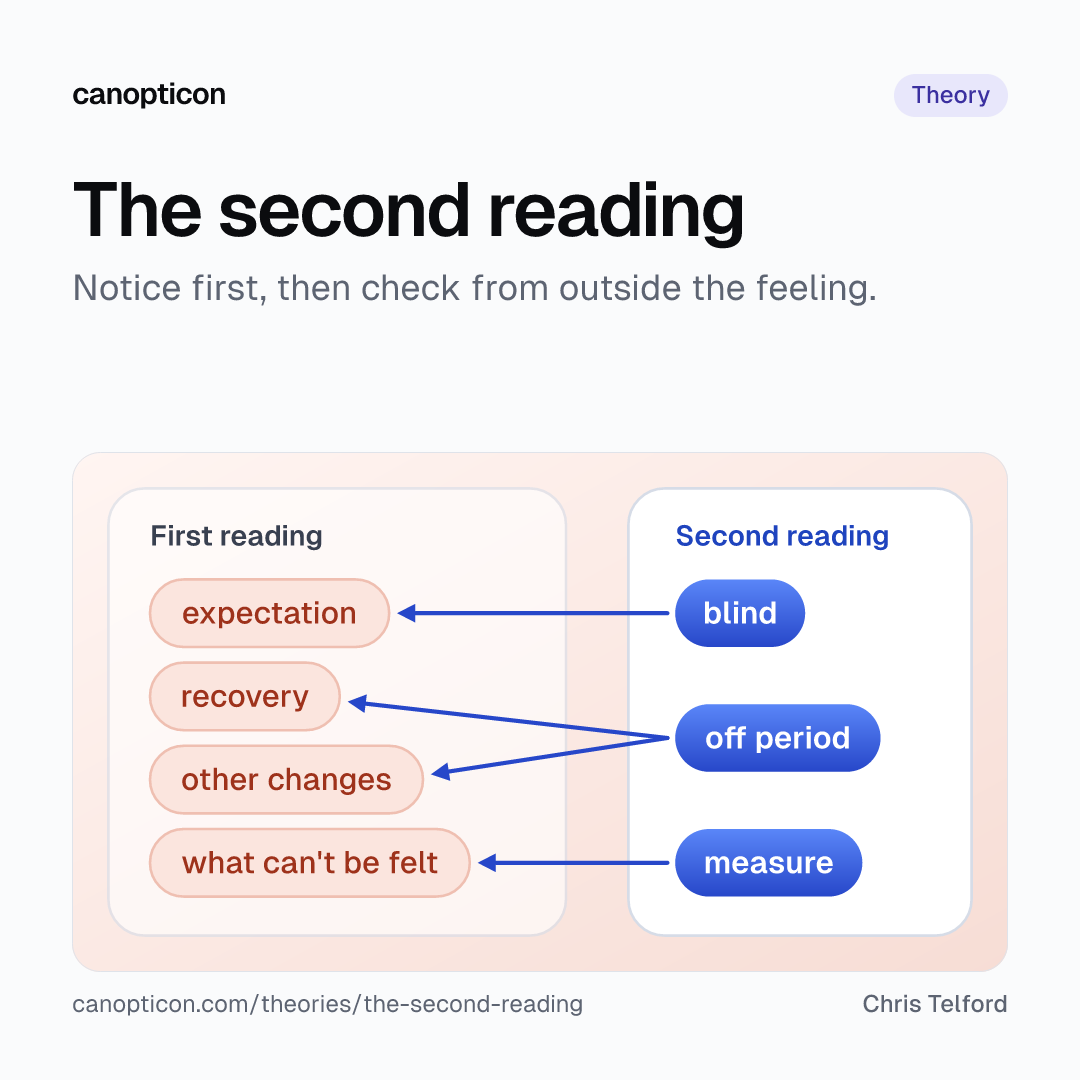
A first reading of whether something works on you (a felt change, one before-and-after, a story you tell yourself about the cause) is genuine early data, but it carries four errors: expectation, recovery that would have happened anyway, other changes made at the same time, and effects that cannot be felt. The first reading cannot detect these errors, because they shape it. A second reading taken through a channel a given error cannot reach removes that error: a measure removes what cannot be felt, a period off removes coincident change and recovery, and a blind removes expectation. So checking is graded, not all or nothing, and each level a person can manage makes the reading more trustworthy than the last.
2 strong · 6 moderate · 2 proposed propositions, resting on 12 primary references. Strong means measured directly in at least two independent studies; moderate, that it follows from established findings but has not been tested as stated; proposed, not yet tested.
Propositions
-
P1
Strong
How much better people feel and how much better they measurably are can come apart.
In a crossover trial in asthma, albuterol raised lung function by 20% against about 7% for a placebo inhaler or sham acupuncture, yet patients reported similar improvement after all three (50%, 45%, 46%), against 21% with no intervention. Across 202 trials of placebo against no treatment, placebo's effects were larger on patient-reported outcomes (SMD −0.26) than on observer-reported ones (SMD −0.13).
-
P2
Strong
Symptoms people attribute to a treatment are often just as present when, unknown to them, they are taking a dummy.
In 60 people who had stopped statins because of side effects, 90% of the symptom burden on the statin also appeared on placebo, and half restarted statins afterwards. In 200 people in a series of blinded n-of-1 trials, muscle symptom scores did not differ between statin and placebo periods (mean difference −0.11), and two thirds of those who finished restarted.
-
P3
Moderate
Starting something at a low point produces an apparent improvement whatever is started, because extreme measurements tend to be followed by less extreme ones.
Regression to the mean follows from any measure that varies from day to day; both papers show how it misleads clinical decisions when people are selected, or select themselves, at a high or low reading.
-
P4
Moderate
People are poor witnesses to what caused their own states, and give confident explanations that do not track the real cause.
Nisbett and Wilson's review of experiments in which people's reports of why they acted or felt as they did matched what an outside observer would guess, not the factor that had been manipulated.
1 reference: [7]
-
P5
Moderate
Intuition is trustworthy where the environment is regular and feedback is quick and clear, and not where it is slow, noisy and confounded, which is the usual situation when judging whether something taken daily helps.
Kahneman and Klein's joint account of when intuitive judgements can be trusted. That judging a daily supplement or routine falls outside those conditions is inferred, not measured.
1 reference: [8]
-
P6
Moderate
People treat a few observations as if they represented the whole, so a short run of good days is read as an effect.
Tversky and Kahneman's 'belief in the law of small numbers', shown even in professional researchers.
1 reference: [9]
-
P7
Moderate
A trial's average can hide large effects in some people and none in others, so whether something helps one person is a question for a test in that person.
Kravitz and colleagues on heterogeneity of treatment effects: an average difference is compatible with a minority helped a great deal and a majority not at all.
1 reference: [10]
-
P8
Moderate
A randomised, blinded test in one person is an accepted way to decide whether a treatment helps that person.
Guyatt and colleagues brought the n-of-1 trial into clinical practice in 1986; the Oxford Centre for Evidence-Based Medicine's 2011 levels put n-of-1 trials at the top level for 'Does this intervention help?'.
-
P9
Proposed
Each level of second reading removes a named error of the first: a measure removes effects that cannot be felt, a period off removes coincident change and recovery, and a blind removes expectation.
Assembled from the errors above. Whether people who take a partial second reading reach better decisions than those who take none has not been tested.
No study yet
-
P10
Proposed
A first reading cannot find its own errors, because they shape what it reports; the check has to come through a channel the error cannot reach.
The remedy proposed in the paper False Quiet for checks silenced by their own response, applied to a person judging an effect on themselves.
No study yet
1Definition
The second reading is a check on a first impression of whether something works, taken through a channel the first impression's errors cannot reach. The first reading is what a person notices: they started something and feel better, or worse. The theory holds that this reading is real data and should be kept, not dismissed, and that it is also incomplete in four known ways it cannot see from the inside. A second reading removes one or more of those blind spots. The levels a second reading comes in, from a measurement to a blinded test in one person, each remove a named error.
The author put the first half of this in a probe, Intuition is just early data, calling intuition "pre-verbal pattern recognition". The second half is what makes early data into a finding.
2Prior work
Most of the parts have names already. The n-of-1 trial, a randomised test in a single patient, was brought into clinical medicine by Gordon Guyatt and colleagues in 1986 [11], and the Oxford Centre for Evidence-Based Medicine ranks it at the top level for whether a treatment helps a given person [12]. Placebo and nocebo effects, regression to the mean [5, 6] and the limits of introspection [7] are long established. Daniel Kahneman and Gary Klein set out when intuition can be trusted [8].
What this theory adds is the arrangement. It treats the first reading as data with a known error profile rather than as either proof or noise, and it grades checking into levels, each tied to the error it removes, so that a person who cannot run a full n-of-1 trial can still say which errors their check has ruled out and which remain. The full trial is the top of the ladder, not the only rung.
3Mechanism
A first reading passes through four errors on its way to the person who has it.
- Expectation. Believing something will help changes how a person feels and what they notice. In an asthma trial, people reported nearly as much improvement after a placebo inhaler as after a real one, though only the real one improved their lungs [1].
- Recovery that would have happened anyway. People start things when they feel worst, and a measure taken at a low point tends to be followed by a less extreme one: regression to the mean [5, 6].
- Other changes. Sleep, food, season, work and other products change at the same time, and the newest thing gets the credit. People explain their own states confidently and often wrongly [7].
- Effects that cannot be felt. An iron level, a blood pressure or a lipid level changes without any sensation, so a feeling can neither confirm nor rule out the effect that matters.
The first reading cannot find these errors because they are part of what it reports. A feeling shaped by expectation feels the same as one that is not. This is the condition the paper False Quiet describes for checks in general: a check cannot correct a reading that its own signal has silenced or shaped, and the remedy is an independent reading. Here the independent reading is the second reading, and the question for any check is which of the four errors it can reach.
4Evidence
The strongest evidence is that felt and measured effects come apart. In the asthma crossover trial, albuterol raised lung function by 20% against about 7% for placebo or sham acupuncture, while self-reported improvement was 50%, 45% and 46% respectively, against 21% with no intervention [1]. Across 202 trials comparing placebo with no treatment, placebo's effects were larger on outcomes patients reported than on outcomes observers measured [2].
The same split runs the other way, for harms. In a trial of 60 people who had stopped statins because of side effects, 90% of the symptom burden they felt on the statin also appeared when they were taking an identical dummy, and half restarted statins afterwards [3]. A larger series of blinded n-of-1 trials in 200 people found no difference in muscle symptoms between statin and placebo periods, and two thirds of those who finished went back to the statin [4]. In both, the first reading was sincere and specific, and a second reading changed the decision.
The other errors rest on established findings: regression to the mean [5, 6], the poor accuracy of introspective reports of cause [7], the conditions under which intuition can be trusted [8], and the habit of reading small samples as representative [9]. Averages from trials, for their part, can hide large individual effects [10], which is why a person's question needs a person's test [11, 12].
That partial second readings improve decisions, level by level, is proposed and untested.
5Measures
- Errors ruled out. For any check, which of the four errors it can reach: expectation, recovery, other changes, effects that cannot be felt.
- Agreement. Whether the second reading agrees with the first in direction and rough size.
- Decision change. Whether the second reading changed what the person did: kept, stopped or changed the thing.
- Reversal. When something is stopped, whether the first reading's change goes back, and whether it returns when restarted.
The theory expects first readings about subjective outcomes such as energy, mood or pain to disagree with blinded second readings more often than first readings about measured outcomes do.
6Protocol
Choose the highest level you can manage. Each removes the errors listed.
- Measure before and after. Pick one number that matters, decided in advance (a blood test, a weight, a count of bad days), and record it before starting and after a set time. Removes: effects that cannot be felt. Leaves: recovery, other changes, expectation.
- Keep a daily rating, then take a period off. Rate the thing you hope it helps on the same scale at the same time each day; after a few weeks, stop for one or two weeks and keep rating, then restart. Write down anything else that changes. Removes: most recovery and coincident change, if the rating falls when off and recovers when on. Leaves: expectation.
- Blind it. Have someone else fill identical capsules, some active and some not, in an order chosen by a coin toss, with at least two periods of each and a gap between them. Compare the periods. Removes: expectation as well.
Never stop a prescribed medicine to run this without the prescriber's agreement.
7A four-question check
- What exactly did I notice, and when did it start?
- Would I have noticed it whatever I took, because I expected to?
- Was I at a low point when I started?
- What else changed at the same time?
8Worked examples
Statin muscle aches. A person stops a statin because their muscles ache, a sincere first reading. In the trials above, they took identical capsules, some statin and some placebo, without knowing which [3, 4]. The aches came in both kinds of month. The second reading, level 3, showed that most of the aches were not caused by the statin, and many restarted it.
A new working routine. Someone starts working in the mornings and feels more productive, a first reading open to expectation and to the season. A level-2 second reading: count finished pieces of work each day for three weeks, then return to the old schedule for two weeks and keep counting, then switch back. If the count rises and falls with the schedule, the first reading holds; if it does not move, the feeling came from somewhere else.
9Scope
The theory applies to effects on one person that are fairly quick to appear, can be measured or rated repeatedly, and go away when the thing is stopped. It does not apply well to effects that take years (preventing a disease), to one-off events, or to treatments that change something permanently. It is a guide to judging effects on oneself; it does not tell anyone else whether a treatment works, and it is no reason to stop a prescribed medicine without the prescriber.
10Counter-evidence
A felt benefit from expectation is still a benefit to the person feeling it, especially for pain or nausea [2]; for those outcomes, the feeling is part of the outcome, and a blinded test answers a narrower question (is it the substance?) than the one the person may care about. Taking a measure can itself change behaviour, so even a level-1 reading is not neutral. Blinding at home is hard when a product has a taste or a smell. Effects that linger after stopping blur an off period. And many tests of one end without a clear answer, so a second reading does not always settle the first; sometimes it only shows that the question is still open.
References
The studies behind the propositions. Each says what was read for this theory: 0 in full, 4 from the abstract, 8 from a secondary account.
- Wechsler, M. E., Kelley, J. M., Boyd, I. O. E., Dutile, S., et al. (2011). Active albuterol or placebo, sham acupuncture, or no intervention in asthma. New England Journal of Medicine, 365(2), 119–126. doi:10.1056/NEJMoa1103319 Publisher · Abstract read · Supports P1
- Hróbjartsson, A., & Gøtzsche, P. C. (2010). Placebo interventions for all clinical conditions. Cochrane Database of Systematic Reviews, CD003974. doi:10.1002/14651858.CD003974.pub3 Publisher · Abstract read · Supports P1
- Wood, F. A., Howard, J. P., Finegold, J. A., Nowbar, A. N., et al. (2020). N-of-1 trial of a statin, placebo, or no treatment to assess side effects. New England Journal of Medicine, 383(22), 2182–2184. doi:10.1056/NEJMc2031173 eprints.whiterose.ac.uk · Cited from a secondary account · Supports P2
- Herrett, E., Williamson, E., Brack, K., Beaumont, D., et al. (2021). Statin treatment and muscle symptoms: series of randomised, placebo controlled n-of-1 trials. BMJ, 372, n135. doi:10.1136/bmj.n135 Publisher · Abstract read · Supports P2
- Barnett, A. G., van der Pols, J. C., & Dobson, A. J. (2005). Regression to the mean: what it is and how to deal with it. International Journal of Epidemiology, 34(1), 215–220. doi:10.1093/ije/dyh299 Publisher · Cited from a secondary account · Supports P3
- Morton, V., & Torgerson, D. J. (2003). Effect of regression to the mean on decision making in health care. BMJ, 326(7398), 1083–1084. doi:10.1136/bmj.326.7398.1083 Publisher · Cited from a secondary account · Supports P3
- Nisbett, R. E., & Wilson, T. D. (1977). Telling more than we can know: verbal reports on mental processes. Psychological Review, 84(3), 231–259. doi:10.1037/0033-295X.84.3.231 Publisher · Cited from a secondary account · Supports P4
- Kahneman, D., & Klein, G. (2009). Conditions for intuitive expertise: a failure to disagree. American Psychologist, 64(6), 515–526. doi:10.1037/a0016755 Publisher · Cited from a secondary account · Supports P5
- Tversky, A., & Kahneman, D. (1971). Belief in the law of small numbers. Psychological Bulletin, 76(2), 105–110. doi:10.1037/h0031322 Publisher · Abstract read · Supports P6
- Kravitz, R. L., Duan, N., & Braslow, J. (2004). Evidence-based medicine, heterogeneity of treatment effects, and the trouble with averages. The Milbank Quarterly, 82(4), 661–687. doi:10.1111/j.0887-378X.2004.00327.x Publisher · Cited from a secondary account · Supports P7
- Guyatt, G., Sackett, D., Taylor, D. W., Chong, J., Roberts, R., & Pugsley, S. (1986). Determining optimal therapy: randomized trials in individual patients. New England Journal of Medicine, 314(14), 889–892. doi:10.1056/NEJM198604033141406 Publisher · Cited from a secondary account · Supports P8
- OCEBM Levels of Evidence Working Group. (2011). The Oxford 2011 Levels of Evidence. Oxford Centre for Evidence-Based Medicine. cebm.ox.ac.uk · Cited from a secondary account · Supports P8